Key takeaways
- Behavioural precision replaces broad segmentation: In 2026, AI lets brands treat each customer as a "segment of one," using real-time signals like location, weather, and purchase history to deliver contextual offers instead of demographic groupings.
- Predictive loyalty becomes the standard: Propensity modelling and Next Best Action (NBA) frameworks let brands anticipate churn, purchase intent, and redemption before customers act — shifting loyalty from reactive campaigns to real-time decisions.
- Zero-party data powers privacy-first personalisation: As third-party cookies disappear, voluntarily shared data becomes loyalty's foundation, built through transparent value exchanges that earn both trust and engagement.
- Engagement-based gamification replaces points-only rewards: Loyalty programs now reward reviews, referrals, and community participation — and multiplayer "Squad Goals" turn loyalty from a discount mechanic into an emotional driver.
- Invisible loyalty defines the experience: The most effective 2026 programs don't feel like programs — they run seamlessly in the background, delivering relevant offers while respecting privacy.
Trend 1: segments of one — AI-driven behavioural personalisation
In 2026, the "segment of one" replaces demographic targeting: AI personalises offers in real time from each customer's own behaviour — location, weather, time of day, and purchase history — instead of grouping people by shared traits.
Loyalty programs have long relied on segments — groups of customers put together by a shared characteristic. Segments can be broad (gender, income) or granular (mothers with young children who buy online during winter sales). But customers in a segment always get basically the same offers, making them tailored and generic at once — limiting true behavioural personalisation and real-time relevance.
This opens a new world of outreach:
- Conventional segments: You send a promotion to everyone who hasn't visited in 30 days, or everyone six months after joining.
- Segments of one: You send one customer a notification at 8:15 AM (her usual commute) for a double-shot oat milk latte (her usual order) because your AI predicts she's at risk of churning — while offering a daily-visitor a challenge to try a new pastry to lift his basket size.
Why 2026 marks the shift to AI-powered personalisation
Three forces are converging to make 2026 the year of the Segment of One:
- AI & Predictive Analytics: We no longer look at just purchase and behavioural histories. AI models can now consider context (weather, location, time of day) to predict future intent.
- The Netflix Effect: Customers are spoiled. If Spotify can curate a "Discover Weekly" playlist just for them, they expect their airline, grocery store, and bank to know them just as well. McKinsey research found 71% of consumers now expect personalised interactions — and 76% get frustrated when they don't get them. Yet only 15% of consumers say the marketing they receive feels "very relevant" — proof that most brands still aren't delivering. Generic rewards now feel like spam — because they are.
- Zero-Party Data: With third-party cookies dying, brands need customers to voluntarily share data. The only way to get that data is to trade it for hyper-personalised value.
How the "Segment of One" changes loyalty mechanics
The "Segment of One" changes the mechanics of loyalty programs in three ways:
Case studies: segments of one in action
- Starbucks (Deep Brew): Starbucks' AI platform doesn't just track points — it personalises the app for every user, surfacing favourite items and suggesting pairings based on local weather. Its engine overlays individual purchase data with context like weather, time, and holidays to generate real-time recommendations; the point-of-sale system can even identify the customer so a barista greets them by name with their usual order. The payoff is concrete — Starbucks has reported a 30% uplift in ROI and 15% growth in customer engagement since adopting AI-driven personalisation.
- Sephora (Beauty Insider): Sephora moved beyond points into personalisation and community. New members share their beauty preferences on joining, so recommendations feel tailored from day one, while a members-only community turns the program into an emotional relationship rather than a pure discount scheme. The scale shows it works — Beauty Insider counts around 17 million members in North America, who drive roughly 80% of the brand's sales. Treating each customer as an individual, with relevant recommendations and a genuine sense of belonging, consistently outperforms one-size-fits-all rewards.
- Grocers: There is already a strong trend away from weekly print circulars to app-based "clipped just for you" coupons that align 100% with individual shopping histories. What better way to get attention than with an offer related to something you already know the customer buys?
If your loyalty program still treats customers as a demographic rather than an individual, you aren't building loyalty — you're renting attention until someone else gets to know them better.
Trend 2: predictive loyalty and the rise of next best action (NBA)
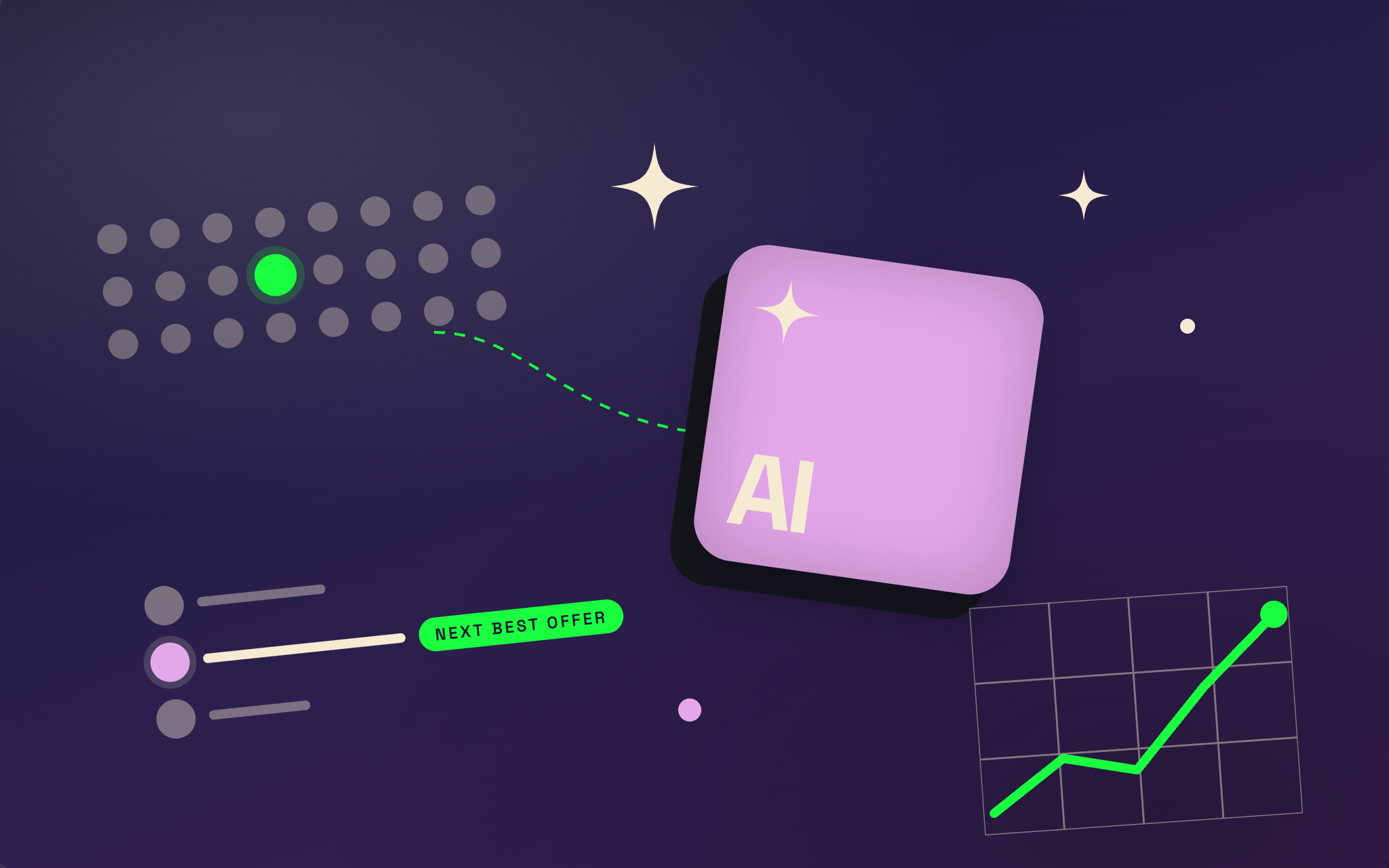
Predictive loyalty uses propensity scoring and Next Best Action (NBA) to anticipate churn, purchase intent, and redemption before they happen — so brands act in real time instead of reacting weeks later.
"Last purchase date" used to be the main metric for spotting at-risk customers. It's now being replaced by something far more useful: propensity to churn.
2026 marks the end of one-size-fits-all loyalty. Blasting the same "Double Points Weekend" email to your whole database now looks as outdated as a punch card full of smudged stamps. The two engines driving the change are propensity modeling and the Next Best Action (NBA) framework.
These scores operate in real time:
- Churn propensity: "Customer A is 85% likely to leave in the next 30 days."
- Purchase propensity: "Customer B is 90% likely to buy running shoes if shown a 10% discount."
- Redemption propensity: "Customer C has a stockpile of points but is only 5% likely to use them without a push."
Why this wins in 2026: emotional vs. transactional loyalty
The biggest trend for 2026 is the shift toward emotional loyalty as the foundation for long-term retention. Transactional loyalty is easier to achieve but fleeting — customers leave the moment a better offer appears. Propensity modeling and NBA let a brand prove it "knows" the customer and act accordingly. When an airline automatically rebooks a tight connection before the customer even lands, that earns more loyalty than any amount of free miles.
Trend 3: zero-party data and consent-based marketing
As third-party cookies disappear, zero-party data — information customers choose to share — becomes loyalty's foundation, exchanged through a transparent "privacy value exchange" where data is traded for real value.
The internet's unspoken rule — "we track you, you get the site for free" — is heading to a museum. The biggest shift in loyalty won't be about points or tiers; it will be about consent. As third-party cookies vanish and privacy rules tighten, brands are losing the ability to follow visitors' footprints. The answer is zero-party data, exchanged through a transparent new contract: the Privacy Value Exchange.
What is zero-party data?
The privacy value exchange explained
The Privacy Value Exchange is a transparent agreement where a customer shares personal data — preferences, intentions, contact details — in direct exchange for tangible value such as better service, discounts, exclusivity, or convenience. It reframes data as a currency the customer owns and chooses to spend.
The "give" — the customer proactively provides zero-party data: preferences ("I wear medium and hate wool"), intent ("I'm looking for a wedding-guest dress"), context ("I'm shopping for my child"), identity (email, birthday).
The "get" — the brand pays in value: financial ("tell us your birthday, get 20% off that month"), convenience ("tell us your skin type, we'll filter out anything that breaks you out"), or experience ("tell us your favourite artists, we'll build your Daily Mix").
Trend 4: gamification goes multiplayer and immersive
In 2026, gamification rewards engagement over spend and turns loyalty social: multiplayer "Squad Goals," review quests, and immersive experiences replace points-only mechanics with emotional participation.
Many consumers have hit loyalty fatigue — phones full of apps used once and forgotten, countless clubs joined for a checkout discount. The brands cutting through in 2026 don't just offer rewards; they offer entertainment and experience. Gamification is moving from transactional ("buy this, get points") to emotional ("play this, feel good").
Beyond points: rewarding engagement and advocacy
Rewarding only spend is now the bare minimum. Brands are incentivising behaviours that build long-term value:
Community-driven and social loyalty models
Loyalty has been a solo sport. In 2026 it's becoming multiplayer. Brands are introducing Squad Goals, where friends pool points or efforts to unlock shared rewards — e.g., "you and 3 friends visit the gym 10 times total this month; hit the goal, everyone gets 20% off." It leverages peer pressure and social proof: churn and you're not letting down a brand, you're letting down your friends.
Generative AI and immersive technology in loyalty design
The evolution of gamification in loyalty programs is being driven by new technical possibilities and advances in customer experience technology. The bar is high and rising — "Spin to Win" can still be effective, but who knows for how much longer.
Generative AI and spatial computing are transforming gamification from a static layer on top of your app into a dynamic engine that drives it, enabling more immersive digital experiences and personalised interactions. We're seeing more movement away from obvious gamification (where you know you're playing a game) toward gamification woven into the experience (where interactions with the brand feel like an adventure), creating deeper emotional engagement and brand connection.
To win in 2026, you don't just need a points engine. You need a game engine.
Trend 5: invisible loyalty and seamless brand interaction
Invisible loyalty is the payoff of the other four trends: when personalisation, prediction, and consent work together, the "program" disappears and loyalty simply feels like a better brand experience.
The best loyalty programs in 2026 are the ones customers hardly notice. The goal isn't to feel like a "program" at all, but a seamless extension of interacting with the brand: the right offer before you search for it, privacy respected without being asked, shopping that feels a little more like play. Technology now lets brands treat every customer as if an entire experience was crafted just for them — because it was.
Turning 2026's trends into action
The throughline across every trend here is the same: loyalty in 2026 is powered by data and AI, but won by making customers feel understood. Personalisation, predictive retention, and real-time engagement all point in one direction — brands that act on what their data is telling them will pull ahead of those still running one-size-fits-all programs.
The hard part isn't knowing the trends; it's knowing where your own program stands against them. Which customers are slipping away? Where is retention leaking? And which of these shifts would move the needle most for your brand?
That's worth finding out before you plan next year. A free loyalty audit will show you where your retention is leaking today — and the fastest way to fix it.